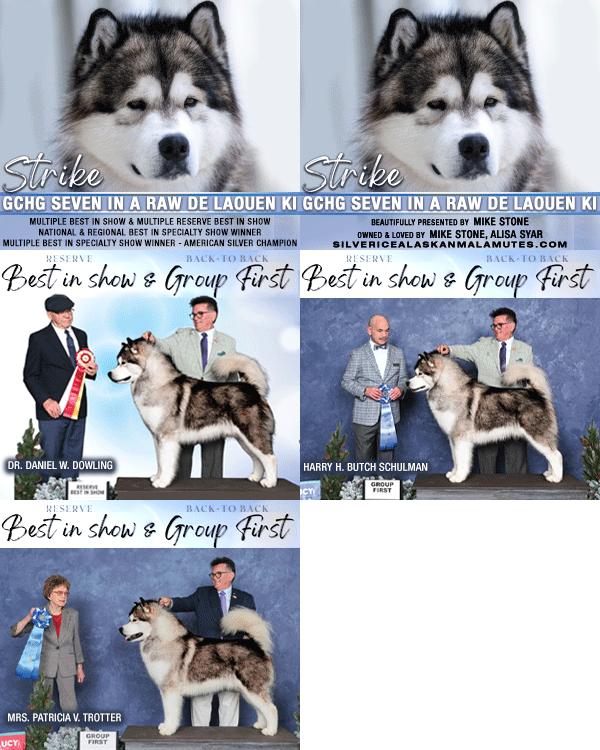
The Progressive Toy Club Group and NOHS Group Competition

The Progressive Toy Club Friday January 30th. Click here to watch on Canine Chronicle TV!

The Progressive Toy Club Friday January 30th. Click here to watch on Canine Chronicle TV!

AKC judge, mentor, and breeder, Linda Clark boasts over four decades of hands-on dog experience. Her journey began at sixteen years old, first working as a groomer’s assistant, before attending school to become a Registered Veterinary Technician (RVT). In 1979, she started in AKC with Shetland Sheepdogs, and since then, she has bred and handled numerous top-winning dogs across multiple breeds, including German Shepherds, Beagles, and Vizslas. A prior member of the AKC Registered Handlers Program and the Professional Handlers Association, Linda retired in 2011 to become an AKC judge. Since her pivot to judging, Linda has been an advocate for our sport, serving as a longtime board member of the Dog Judges Association of America (DJAA). She is also a member of many local dog clubs.

Click here to watch on Canine Chronicle TV! Your clothing questions answered. It’s all about putting the power back in your hands by letting you ask questions. Should you wear this or that? What should you donate? How do you mix and match? How do you ensure your clothing isn’t wearing you? Elaine answers all [...]

Despite being born and growing up in the land that brought us such classics as ‘Tarka the Otter’ (a master class of exquisitely beautiful writing, and a book that has never been out of print since first being published in 1927) and ‘Ring of Bright Water’ (which documented Gavin Maxwell’s life in the wilds of Scotland, and his close association with several wild otters–and it is also considered a literary masterpiece), I hadn’t actually seen a wild otter until I visited Vancouver back in 2017.

With AKC judges, breeders, and TV personalities Wayne Cavanaugh & Kimberly Meredith Brought to you by The Canine Chronicle Real talk. Bold takes. No fluff. The blogcast that goes beyond the ring — from two insiders who’ve lived it all… and are Still Standing. Watch. Listen. Only at The Canine Chronicle. Click here to watch on Canine Chronicle TV!

Click here to listen on Canine Chronicle TV! Award-winning audio producer and Canine Chronicle feature writer Sarah Montague has created an audio documentary celebrating the 150th anniversary of this iconic event. It moves from the Club’s founding in 1877 to the edge of this year’s show. On the way, we hear about a storied past; [...]

After reading Tom Grabe’s insightful From the Publisher editorial on the direction of local kennel clubs, I was inspired to write this article. This is, in my view, such an important subject that echoes all around the dog fancy.

With 56 years in the sport of purebred dogs as a breeder, owner-handler, professional handler, and judge, David has experienced our industry in ways few have. Tune in to Canine Chronicle TV as he talks to Elaine about his life in purebred dogs, the sport, and this year’s once-in-a-lifetime assignment judging BIS at the 150th [...]

Take two fingers, starting at the top of your shoulder, and trace the bone that runs horizontally from the top of your shoulder blade (scapula) to the bone (sternum) that sits vertically in the center of your rib cage. That horizontal connecting bone is your clavicle, less formerly known as the collar bone. They are easy to find and see because, unlike most bones, clavicles are not covered in muscle; they are only covered by skin. They are also the only horizontal bones in our body. Most important, however, clavicles connect our arms to our torso. Why is it important to know that humans have a collar bone that actually connects our shoulders to our torso? Because dogs do not.

When the first Westminster Kennel Club Dog Show was held in 1877, the United States was still emerging from the shadow of the Civil War. The nation was rebuilding—physically, culturally, and emotionally—and the idea of gathering to celebrate purebred dogs reflected a quiet confidence in continuity and purpose. What began just a dozen years after the war’s end would become an institution that has now endured for 150 years, spanning generations few traditions ever reach.